




































The death sentence handed down to Sheikh Hasina—Bangladesh’s longest-serving prime minister—for crimes against humanity has sent shockwaves through the nation. Far from delivering justice, it signals a perilous descent into political vengeance cloaked in legal formality.
Political analysts and rights advocates warn that this high-voltage, politically orchestrated verdict is not merely punitive—it is part of a broader scheme to dismantle the very foundations of independent Bangladesh.
The country born in 1971 through a bloody liberation war against West Pakistan’s systematic oppression now finds its sovereignty threatened from within.
Sheikh Hasina’s Response
From exile in India, Sheikh Hasina issued a blistering rebuttal to the verdict delivered in absentia by Bangladesh’s International Crimes Tribunal. She condemned the ruling as a manifestation of “brazen and murderous intent” by extremist elements within an unelected interim government.
Hasina categorically denied all charges, asserting that neither she nor her party ordered violence against protestors. “I mourn every life lost in July and August of last year—on both sides of the political divide. But I did not order killings, and neither did my colleagues,” she stated.
She further criticized the tribunal’s lack of impartiality and procedural integrity:
“Despite its name, there is nothing ‘international’ about the ICT. Nor is it impartial. I was denied the right to choose my own legal counsel. The proceedings were rigged from the start.”
Hasina cited three incontrovertible facts:
- Senior judges and advocates sympathetic to her party were removed or silenced.
- The ICT has exclusively targeted members of the Awami League.
- No effort has been made to investigate or prosecute documented violence by other political factions, including attacks on religious minorities.
“Bangladeshis Will Not Be Fooled”
Hasina warned that the Bangladeshi people—especially those suffering under the chaotic and regressive administration of Nobel laureate Dr. Muhammad Yunus—would not be deceived by the tribunal’s theatrics.
“These trials were never about justice. They were designed to scapegoat the Awami League and distract from the failures of Dr. Yunus’s unelected regime.”
She emphasized that Yunus, who heads the interim government, has never received a single vote from the Bangladeshi electorate. “This is not democracy. This is manipulation,” she declared.
Her son, Sajeeb Wazed, echoed the sentiment, stating that the family would not appeal the verdict unless a democratically elected government—including the Awami League—was restored.
Human Rights and International Scrutiny
Global rights organizations and legal experts have raised serious concerns about the tribunal’s conduct:
- The trial was conducted in absentia, with limited access to defense resources.
- International observers were excluded, undermining transparency.
- The speed and timing of the verdict suggest political motivations ahead of the 2026 elections.
Expert Commentary
- Abbas Faiz, South Asia researcher: “The verdict may reflect the interim government’s attempt to align with public sentiment before elections.”
- Thomas Kean, International Crisis Group: “While procedural flaws are evident, the gravity of Hasina’s alleged actions cannot be ignored.”
A Nation Haunted by Its Own History
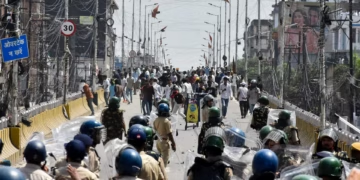
Bangladesh’s history is steeped in trauma—from the genocide of 1971 to the assassinations and street violence that followed. The tribunal’s verdict against Hasina, citing her role in the 2024 crackdown that killed over a thousand student protestors, is unprecedented. Not since the war crimes trials of the 2010s has the judiciary wielded such symbolic force.
But justice must not only be done—it must be seen to be done. The opacity of the trial, its exclusionary tactics, and the absence of international oversight raise grave doubts. Hasina calls it a “kangaroo court.” Her critics call it overdue. Her supporters call it a witch hunt.
The question now is not just about one leader’s fate. It is about the soul of a nation.