

































*Introduction: Strategic Power in the Age of Precision*
The architecture of global power in the twenty–first century is increasingly defined not by territorial expansion or the Mobilisation of mass armies, but by the sophistication, speed, and precision of missile technologies. Contemporary military strength is therefore measured less by the scale of conventional forces and more by a state’s capacity to project power through integrated aerospace systems, satellite intelligence, cyber capabilities, and advanced missile platforms (Freedman, 2017).
Missiles have consequently emerged as the most visible instruments of modern strategic signalling. They function not merely as weapons of war but as geopolitical tools—mechanisms of deterrence capable of shaping diplomatic behaviour, Stabilising regional balances, and reinforcing national sovereignty (Schelling, 1966). Within this evolving strategic landscape, a clear distinction has developed between democratic defence systems—Characterised by transparency, alliance-based cooperation, and regulatory oversight—and the increasingly opaque missile developments pursued by several authoritarian states. This divergence carries significant implications for the future of international security.
*Strategic Missile Systems: Categories and Operational Functions*
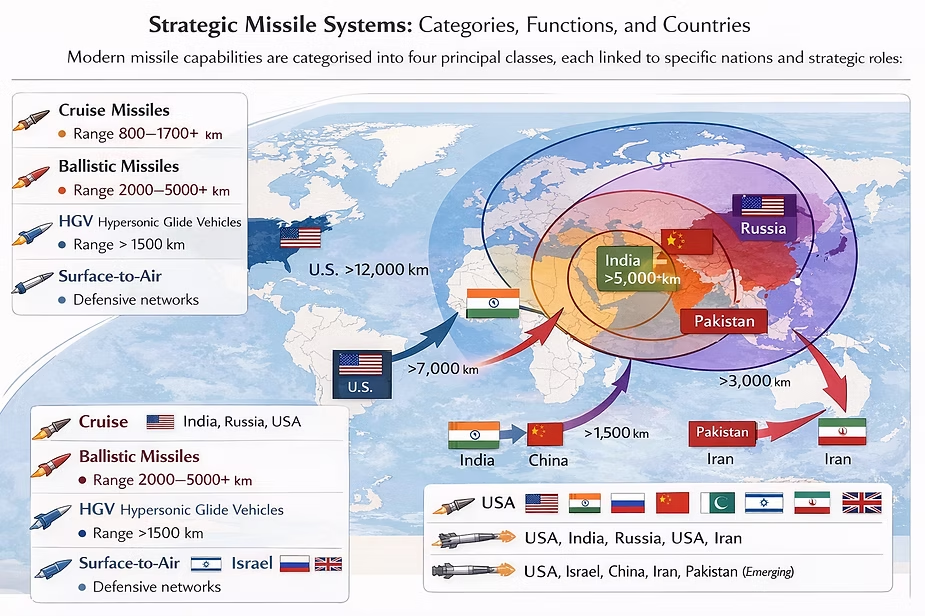
Modern missile capabilities can broadly be Categorised into four principal classes, each fulfilling a distinct operational function within contemporary military doctrine.
I) Cruise missiles represent one of the most versatile precision-strike technologies. Designed to travel at low altitudes while following pre-programmed navigation paths, these systems evade radar detection and deliver highly accurate strikes against strategic targets. Prominent examples include the Indo–Russian BrahMos missile and the American Tomahawk, the latter possessing an operational range of approximately 1,700 kilometres (Missile Defense Project, 2023).
- II) Ballistic missiles remain central to nuclear deterrence doctrines. These systems follow a parabolic trajectory, travelling into the upper atmosphere before re-entering at extremely high speeds. Systems such as India’s Agni-V, China’s DF-41, and Pakistan’s Shaheen-III exemplify this category. The Agni-V, with a range exceeding 5,000 kilometres, significantly enhances India’s long-range strategic deterrence capability (IISS, 2024).
III) Hypersonic glide vehicles (HGVs) represent the newest frontier in missile development. Travelling at speeds above Mach 5 while maintaining manoeuvrability, these systems are capable of evading traditional missile defence architectures. Russia’s Avangard and China’s DF-17 demonstrate the emerging importance of hypersonic capabilities in contemporary strategic competition (Acton, 2018).
- IV) Surface-to-air missile systems (SAMs) provide defensive protection against incoming aircraft, drones, and missiles. Systems such as Israel’s Arrow-3, Russia’s S-400, and the United Kingdom’s Sky Sabre form essential components of integrated air-defence networks designed to safeguard national airspace (IISS, 2024).
*Democratic Defence Powers and Their Strategic Capabilities*
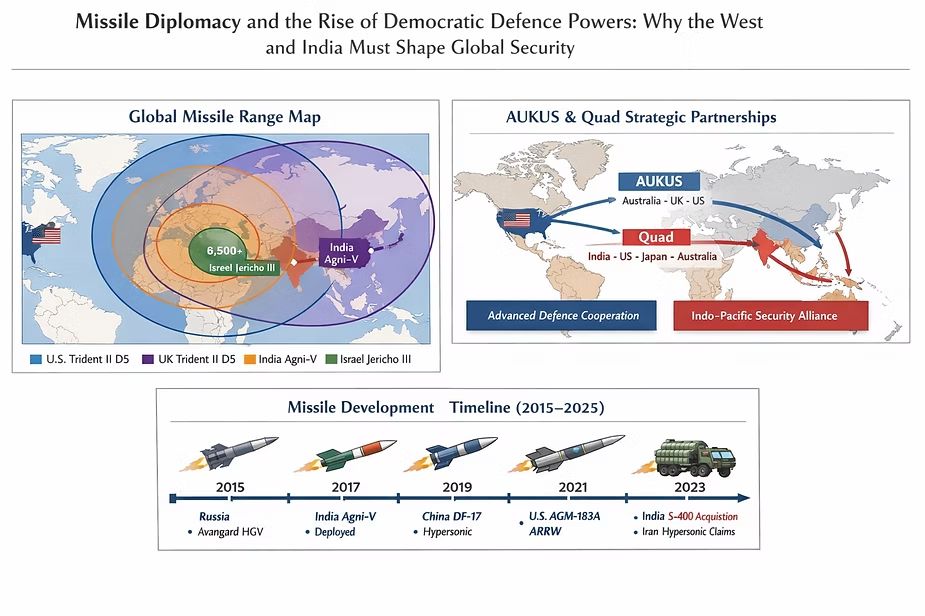
Several democratic states maintain advanced missile infrastructures that combine technological innovation with alliance-based security frameworks. The United States operates the most extensive missile ecosystem globally. Systems such as the AGM-183A Air-launched Rapid Response Weapon (ARRW) illustrate continued American leadership in hypersonic weapons research. Complementary defensive systems such as THAAD and Patriot provide layered missile defence capabilities integrated across NATO and allied military networks (Congressional Research Service, 2023). The United Kingdom maintains a credible nuclear deterrent through the Trident II D5 submarine-launched ballistic missile system, capable of reaching targets at distances exceeding 7,000 kilometres. Continuous at-sea deterrence conducted by the Royal Navy ensures Survivable second-strike capability, a cornerstone of NATO strategic stability (Freedman, 2017).
Israel possesses one of the most advanced layered missile defence systems in the world. The Iron Dome system intercepts short-range projectiles, while Arrow-3 provides exo-atmospheric interception of ballistic missiles. Israel’s Jericho III missile system reportedly provides intercontinental deterrence capability, reinforcing regional strategic balance (Missile Defense Project, 2023).
India has emerged as an increasingly influential missile power within the Indo-Pacific region. The BrahMos cruise missile is widely regarded as one of the fastest operational cruise missiles globally. India’s Agni missile series, particularly Agni-V, provides credible long-range deterrence and reflects the country’s growing technological sophistication. India’s procurement of the S-400 air defence system and its expanding cooperation within the Quadrilateral Security Dialogue (Quad) further demonstrate its rising strategic role (Tellis, 2021).
*The Authoritarian Missile Axis: Strategic Challenges*
Alongside democratic defence cooperation, several authoritarian states continue to expand their missile arsenals. Russia has Prioritised advanced hypersonic and strategic missile systems such as the Zircon hypersonic cruise missile and the Avangard glide vehicle, technologies designed specifically to evade existing missile defence systems (Acton, 2018).
China has developed a comprehensive missile Modernisation programme including the DF-17 hypersonic glide vehicle and the DF-21D anti-ship ballistic missile, often described as a “carrier-killer”. These systems form part of China’s broader anti-access and area-denial strategy within the Indo-Pacific region (IISS, 2024).
Meanwhile, Pakistan continues to expand its ballistic missile capabilities, notably with the Shaheen-III, capable of striking targets up to 2,750 kilometres away. Iran has developed medium-range missiles such as the Sejjil and has announced hypersonic research programmes, although the full operational capabilities of these systems remain subject to international verification (Missile Defense Project, 2023). The principal concern surrounding these programmes lies not solely in their technological development but also in the limited transparency accompanying their deployment and doctrinal use.
*Missile Power and Strategic Deterrence*
Missile systems exert significant influence over global diplomacy and strategic calculations. Long-range strike capabilities serve as powerful deterrents, preventing conflict through the credible threat of retaliation (Schelling, 1966). India’s Agni-V provides coverage across much of Asia, while Israel’s Jericho III reportedly offers intercontinental reach. The Trident II D5 missiles deployed by the United Kingdom and the United States represent one of the most survivable elements of nuclear deterrence due to their submarine-based deployment and stealth capabilities. At the same time, defensive missile systems have transformed national security strategies. Platforms such as Iron Dome, Arrow-3, and advanced radar networks illustrate how integrated defence architectures can significantly reduce civilian vulnerability to missile attacks (Missile Defense Project, 2023).
*Democratic Collaboration and the Future Security Architecture*
In contrast to unilateral military expansion, democratic states increasingly pursue missile capabilities through cooperative frameworks. The AUKUS security partnership between Australia, the United Kingdom, and the United States aims to enhance technological collaboration and deterrence within the Indo-Pacific region. Similarly, the Quad—comprising India, the United States, Japan, and Australia—focuses on maritime security, technological cooperation, and strategic stability. Participation in international frameworks such as the Missile Technology Control Regime (MTCR) demonstrates a commitment to regulating the proliferation of missile technologies and ensuring responsible defence cooperation.
India’s export of the BrahMos missile system to partners such as the Philippines represents an example of how defence collaboration can enhance regional security while remaining consistent with international regulatory norms (Tellis, 2021).
*Conclusion: Precision, Responsibility, and Strategic Stability*
The rapid acceleration of missile innovation signals a transformative phase in global security. Hypersonic weapons, artificial-intelligence-guided targeting systems, and satellite-integrated surveillance networks are reshaping the strategic landscape at unprecedented speed.
Yet technological capability alone cannot guarantee stability. The credibility of strategic power ultimately rests upon the principles governing its use. Democratic states—through transparency, legal accountability, and alliance-based cooperation—possess institutional frameworks capable of managing advanced military technologies responsibly. As missile systems become capable of crossing continents within minutes, the defining challenge of the coming decades will not merely concern who possesses these weapons, but how they are governed. The preservation of global stability will therefore depend upon the ability of responsible nations to combine technological excellence with ethical restraint.
In the emerging era of missile diplomacy, peace will require not only stronger shields but wiser guardians.
*References*
Acton, J. (2018) Hypersonic Weapons and Strategic Stability. Washington DC: Carnegie Endowment for International Peace. Congressional Research Service (2023) Hypersonic Weapons: Background and Issues for Congress. Washington DC: U.S. Congress. Freedman, L. (2017) The Future of War: A History. London: Allen Lane.
International Institute for Strategic Studies (IISS) (2024) The Military Balance 2024. London: Routledge. Missile Defense Project (2023) Missile Threat: CSIS Missile Defense Database. Washington DC: Center for Strategic and International Studies.
Schelling, T. (1966) Arms and Influence. New Haven: Yale University Press.
Tellis, A. J. (2021) Striking Asymmetries: Nuclear Transitions in Southern Asia. Washington DC: Carnegie Endowment for International Peace.
© 2025 Nila Bala (Balananthini Balasubramaniam), Small Drops. All Rights Reserved.
This article constitutes the intellectual property of the author and may not be reproduced, stored, transmitted, or distributed in any form without prior written permission from the author or the Small Drops organisation.