












































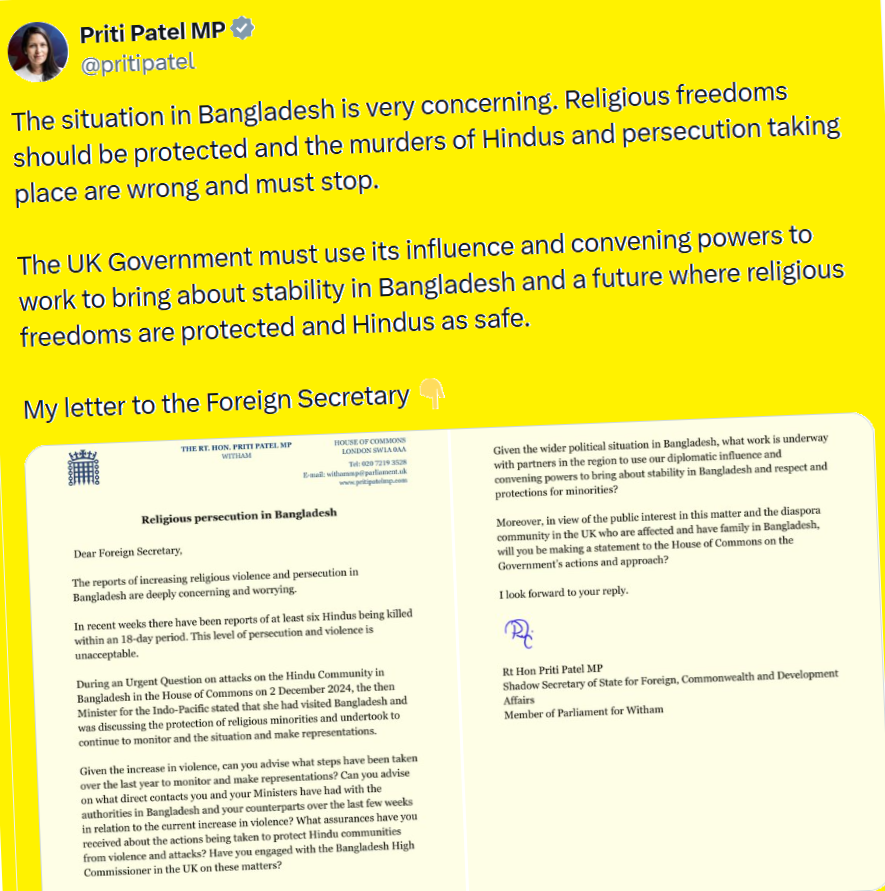
When a former UK Home Secretary raises the alarm about escalating violence in Bangladesh, Parliament should pay attention. Priti Patel’s letter on 9 January 2026 to the Foreign Secretary is not political theatre—it is a warning that a Commonwealth partner is facing a human‑rights crisis that Britain can no longer afford to ignore.
Her message is stark: Hindus in Bangladesh are being murdered, persecuted, and driven into fear. Religious freedoms—supposedly guaranteed—are being eroded in plain sight. These abuses are not abstract. They are targeted. They are brutal. And they are happening now.
For too long, the UK has responded with polite concern rather than decisive action. That approach is no longer tenable.
Bangladesh is a nation with which Britain shares deep ties: historic, cultural, economic, and diasporic. Nearly a million British citizens trace their heritage to Bangladesh. When minorities are attacked in Dhaka, Chattogram, or Sylhet, the shockwaves are felt in London, Birmingham, Manchester, and beyond. This is not a distant issue—it is a British issue.
And yet, despite mounting evidence of killings, mob violence, intimidation, and the systematic targeting of Hindu communities, the UK’s response has not been strong. That sends a wrong message: that the rights of minorities are negotiable, and that Britain will look away when its partners violate the very freedoms it claims to defend.
This is not the Britain Parliament says it wants to be.
The UK has influence. It has diplomatic weight. It has convening power. And it has a moral obligation to use them.
MPs across parties should now press the Foreign Office to take three urgent steps:
- Demand accountability for attacks on Hindus and other minorities.
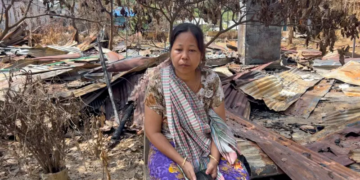
The UK should call for independent investigations into killings, mob violence, and the destruction of homes and temples. Impunity fuels further violence. - Mobilise international partners.
Britain can bring together Commonwealth states, UN bodies, and human‑rights organisations to push for concrete protections and monitoring mechanisms. Stability in Bangladesh is a regional and global interest. - Make religious freedom a non‑negotiable pillar of UK–Bangladesh relations.
Trade, development, and security cooperation must be tied to credible commitments to protect minorities and uphold constitutional rights.
This is not interference. It is principled diplomacy.
Bangladesh’s future stability depends on safeguarding pluralism. A nation cannot thrive when its minorities live in fear. A democracy cannot function when violence becomes a tool of intimidation. And Britain cannot claim to champion human rights abroad while remaining silent when those rights are trampled in a country with which it shares such profound bonds.
Patel’s intervention should be a catalyst. MPs now have a choice: respond with urgency, or allow the situation to deteriorate further.
The UK must stand with those whose voices are being silenced. It must defend the right to worship freely. And it must make clear that the persecution of Hindus—or any minority—has no place in a modern, democratic Bangladesh.