




















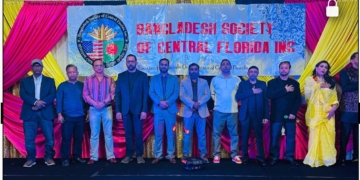

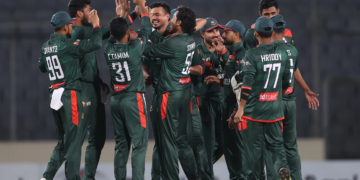










ICC deputy Chairman Khawaja Imran Bangladesh Cricket board president Ameen ul Islam in Lahore today in meeting with PCB Chairman Mohsin Naqvi, to decide possibility of Pakistan and Bangladesh in the T20 world cup. Pakistan has allowed its cricket team to participate in the upcoming T20 World Cup, but it has stopped the team from playing against India. This decision by the Government of Pakistan is being widely praised. It is especially appreciated because many people feared that if Pakistan completely boycotted the T20 World Cup, it would harm cricket and deeply hurt the emotions of national team players.
However, India’s government was very happy at the prospect of a boycott, as it has long been trying to isolate Pakistan in cricket. Now that Pakistan has decided to participate, a positive atmosphere has emerged within the country, while there is mourning and frustration in India. According to Indian journalists, Pakistan’s decision has created tension and an unpleasant situation in the T20 World Cup.
On the other hand, Pakistani analysts say that Pakistan’s decision is principled and based on equality. They argue that India has repeatedly taken decisions against Pakistan in violation of cricketing principles. These include changing match schedules and humiliating behavior toward the Pakistani team during matches.
It is not a new matter that the Indian cricket team has refused to play in Pakistan. Just last October, when the Asia Cup was supposed to be held in Pakistan, the Indian team refused to come, citing security concerns. This excuse had no solid basis because several international teams had already toured Pakistan, completed their series safely, and even expressed happiness after playing there. Nevertheless, due to India’s refusal, the Asia Cup was shifted away from Pakistan, breaking the hearts of Pakistani fans and crushing their joy.
India has been hostile toward Pakistan from the very beginning and tries to harm Pakistan wherever and whenever it can, purely for political reasons. Since the rise of the extremist Hindutva government in India, hostility toward Pakistan has crossed all limits. Previously, despite political tensions, sports were kept separate from politics. But now, political interference in cricket has damaged the spirit of the game and hurt the emotions of fans worldwide.
An Indian poet and analyst, Akal Puriya, mocked Pakistan’s decision by claiming that Pakistan refused to play India because it lost badly to India in the 2019 World Cup, and that this decision is merely an attempt to hide embarrassment.
Meanwhile, Indian Member of Parliament and well-known politician Shashi Tharoor suggested that Pakistan’s refusal to play India in the T20 World Cup should prompt the Indian government to reconsider its hateful policies. He said that the Modi government has filled India with hatred and has also dragged politics into cricket, badly damaging the game.
Former senior Pakistan cricketer Khalid Mahmood stated that the Pakistan Cricket Board should call an ICC meeting and raise India’s misconduct and politicization of cricket, especially in front of Australia, New Zealand, and England. He said India is polluting cricket by using it for political gain, even though cricket should remain only a sport and have nothing to do with politics.
The reality is that political interference in cricket began primarily during the Modi government’s era. If this is not stopped, cricket will turn into a joke and lose its global importance.
Pakistan’s refusal to play India is not merely about India; in fact, Pakistan has raised its voice against India’s unfair treatment of Bangladesh as well. It is unjust that India plays cricket wherever it wants and cancels matches wherever it pleases, while other cricket-playing nations remain silent. This silence has allowed India to bully world cricket.
Some analysts say India dominates world cricket mainly because of its large population and massive revenue generation. This is also true: most of global cricket’s earnings come from India. According to one estimate, world cricket has generated about one billion dollars over the past 20 years, with India contributing the largest share. India earns heavily from bilateral series, and the ICC also receives a major portion of its revenue from India.
Because of India’s financial dominance, the ICC has effectively become like an Indian cricket club, where no decision is made against India’s wishes. It is clear that the BJP-led Indian government uses the ICC for its own interests.
Currently, India’s relations with Bangladesh are also deteriorating. Bangladesh’s interim government has distanced itself from India after the fall of Sheikh Hasina, a move supported by the Bangladeshi public. Last year, Bangladeshi youth forced Hasina’s government out, and she fled to India after being accused of killings. She is currently living in India under the Modi government’s protection, despite Bangladeshi courts sentencing her to death for the murder of innocent citizens. India has refused to hand her over.
Due to these strained relations, Bangladeshi players were initially included in the IPL but were later removed. As a result, the Bangladeshi government stopped its cricket team from touring India.
Since India treated Bangladesh unfairly, Pakistan supported Bangladesh’s rightful stance. That is why Pakistan allowed its team to participate in the T20 World Cup but prohibited it from playing against India.
India is now angered by Pakistan’s bold decision, yet it cannot take action against Pakistan because Pakistan has not violated any ICC rules. By refusing to play India, Pakistan has highlighted India’s biased attitude without breaking any cricketing laws.