


































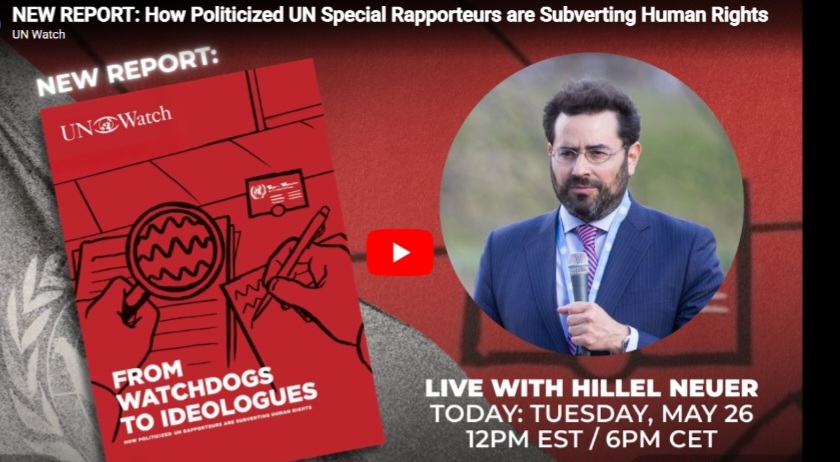
A major new report by Geneva‑based UN Watch — further analysed by the New York-based Gatestone Institute — dismantles the long standing assumption that UN Special Rapporteurs and OHCHR fact finding teams operate with neutrality. The investigation, How Politicized UN Rapporteurs Are Subverting Human Rights, documents how thirteen high level UN teams have drifted from objective analysis into overt political advocacy.
Several Special Rapporteurs tasked with monitoring counterterrorism, torture, and human rights have reportedly accepted hundreds of thousands — in some cases more than a million — dollars in direct funding from governments such as China, Russia, and Qatar. These arrangements, often undisclosed, create an obvious conflict of interest. And the consequences are visible: muted criticism of regimes implicated in mass atrocities.
Bangladesh: A Case Study in Eroding Credibility
Bangladesh’s July Movement offers a stark example of how selective evidence and political convenience can distort international reporting.
The UN’s February 2025 report on the so-called anti-quota protests was intended to be an neutral account of a national trauma. Instead, it has become a contested document facing formal legal challenge. Critics argue that the report is marred by errors, exaggerations, and omissions that fundamentally compromise its reliability.
The most serious concern is methodological. The UN attributed roughly 1,400 deaths to the unrest — a figure that has shaped international commentary and legal proceedings. Yet subsequent scrutiny suggests the conclusion was drawn from a remarkably small interview pool, with no direct testimony from victims, families, or frontline witnesses. Domestic records, including official publications and movement‑related tallies, reported significantly lower casualty figures.
The problem is not simply numerical; it is epistemic. How can a global institution justify extrapolating nationwide conclusions from such limited evidence?
The Gatestone critique argues that UN human rights experts have, in multiple contexts, adopted activist‑driven narratives, relied on unverified claims, and produced assessments that appear to validate predetermined political framings. Bangladesh fits this pattern almost too neatly. Observers note that the UN’s report closely mirrored the messaging of the interim administration installed on 8 August 2024 — a government whose legitimacy remains contested.
More troubling still are allegations of selective editing. Investigative findings suggest that early drafts contained details of violence against law enforcement personnel — details that vanished from the final publication. Such omissions raise uncomfortable questions: Who decides which victims matter? And what happens when an international report highlights one category of suffering while erasing another?
When Authority Falters, Trust Collapses
The UN’s authority rests on impartiality. Once that perception falters, confidence collapses quickly. Bangladesh’s geopolitical position — bordering Myanmar’s volatile Rakhine State and sitting at a strategic crossroads between South and Southeast Asia — only heightens the stakes. Every international intervention is interpreted through the prism of power politics. It is unsurprising, then, that critics have begun asking whether diplomatic objectives influenced the evolution of the UN’s report.
The contradictions within the UN’s own document deepen the unease. The report cautions against its use as courtroom evidence, yet it has already shaped discussions in legal forums. If a report acknowledges its own limitations, how appropriate is it for it to influence proceedings that may determine political accountability?
A System in Need of Reform
It is a warning — one echoed by Bangladesh’s experience — that the UN’s human rights architecture is facing a credibility crisis. When fact‑finding becomes entangled with politics, when sample sizes shrink and narratives expand, when drafts shift mysteriously before publication, the result is not accountability but confusion.
The fundamental flaw is structural: a human rights apparatus that has replaced rigorous, even‑handed investigation with predetermined narratives. When “independent” experts can accept millions in funding from foreign governments, or when fact‑finding missions omit evidence that complicates preferred political outcomes, the entire framework of international accountability collapses.
For Bangladesh, the stakes are immense. For the United Nations, they may be greater still. A human rights system that cannot withstand scrutiny cannot command trust. And without trust, even the most urgent warnings risk becoming just another contested narrative in an increasingly polarised world.