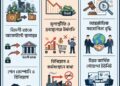
































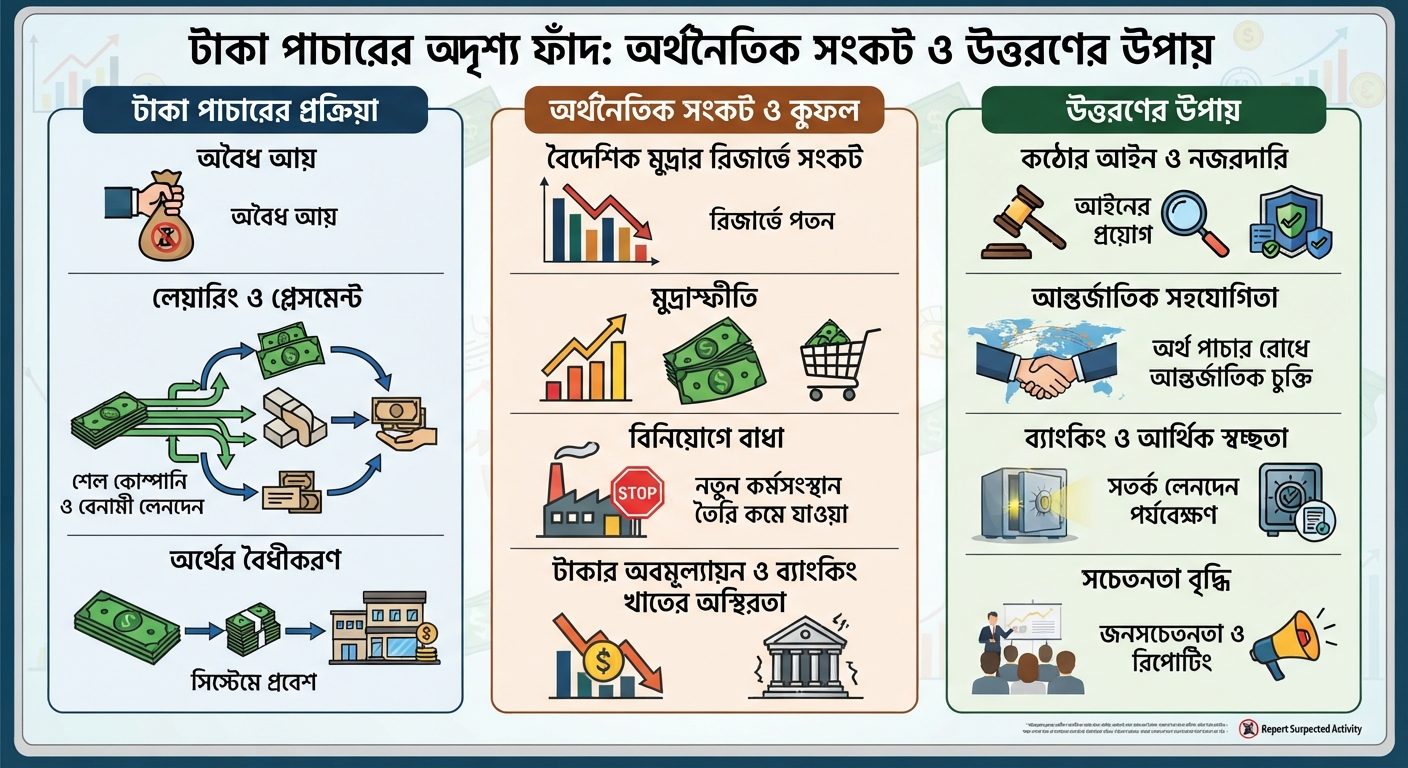
Our country appears to be at risk of gradually turning into an invisible machine for money laundering. Allegations are surfacing that vast sums of money are being siphoned abroad by any means possible whenever the opportunity arises. “Observing the situation, one is compelled to ask: despite initiatives to curb money laundering, why do allegations of funds being moved abroad keep cropping up?” It seems as though, rather than stopping money laundering, an undeclared competition is underway in some quarters—a race to see who can siphon off the most money abroad. Laws, institutions, and various measures exist to halt money laundering and repatriate the laundered funds; however, questions regarding the effectiveness of these measures persist. Merely having laws in place is insufficient; proper enforcement, investigative capacity, accountability of relevant institutions, and effective institutional and administrative cooperation must also be ensured.
A country’s economy cannot be judged solely by its GDP, foreign currency reserves, or per capita income. Questions regarding where the country’s funds are going, how they are being moved, and the extent to which they are utilized for the welfare of the people are equally important. Discussions concerning money laundering and illicit financial flows in Bangladesh have been ongoing for a long time. Recent activities by government agencies, reports on suspicious transactions, and initiatives to recover assets laundered abroad have once again highlighted the magnitude and complexity of this issue. According to the Bangladesh Bank’s annual report for the 2024–25 fiscal year, the ‘Inter-Agency Task Force on Stolen Asset Recovery and Management’ has been reconstituted to identify, investigate, and repatriate funds and assets laundered abroad. The Governor of Bangladesh Bank leads this task force, while the Bangladesh Financial Intelligence Unit (BFIU) serves as the coordinator. The report further states that joint investigation teams have been formed to prioritize eleven money laundering cases of national importance. The Anti-Corruption Commission (ACC), the Criminal Investigation Department (CID), Customs Intelligence, and the BFIU are collaborating within these teams. Requests for Mutual Legal Assistance have also been sent to foreign authorities.
A country’s economy cannot be judged solely by its GDP, foreign currency reserves, or per capita income. Questions regarding where the country’s funds are going, how they are being moved, and the extent to which they are utilized for the welfare of the people are equally important. Discussions concerning money laundering and illicit financial flows in Bangladesh have been ongoing for a long time. Recent activities by government agencies, reports on suspicious transactions, and initiatives to recover assets laundered abroad have once again highlighted the magnitude and complexity of this issue. According to the Bangladesh Bank’s annual report for the 2024–25 fiscal year, the ‘Inter-Agency Task Force on Stolen Asset Recovery and Management’ has been reconstituted to identify, investigate, and repatriate funds and assets laundered abroad. The Governor of Bangladesh Bank leads this task force, while the Bangladesh Financial Intelligence Unit (BFIU) serves as the coordinator. The report further states that joint investigation teams have been formed to prioritize eleven money laundering cases of national importance. The Anti-Corruption Commission (ACC), the Criminal Investigation Department (CID), Customs Intelligence, and the BFIU are collaborating within these teams. Requests for Mutual Legal Assistance have also been sent to foreign authorities.
When the nation’s wealth is illegally siphoned off abroad, prospects for investment, employment, and development are undermined. The state loses revenue, while ordinary citizens are forced to bear the long-term consequences. Consequently, the wealth gap between the rich and the poor may widen, potentially fueling social unrest. Moreover, when economic crimes go unpunished or cases drag on indefinitely, it sends a dangerous message to society: that one can get away with illegally amassing wealth. This risks eroding public morality, humanity, and core values. It also becomes difficult to curb crimes such as bribery, corruption, fraud, extortion, mugging, murder, and mob violence, as a decline in public trust in the law inevitably weakens social order. Money laundering should not be viewed merely as an economic crime; it must also be seen as an issue concerning the state’s economic security, social justice, and the rights of future generations.
According to BFIU data, the number of reports regarding suspicious transactions and activities rose by 23 percent in the 2023–24 fiscal year, reaching 17,345. Of these, 11,736 were Suspicious Transaction Reports (STRs) and 5,609 were Suspicious Activity Reports (SARs). During that fiscal year, the BFIU forwarded 114 Financial Intelligence Reports to various investigative agencies. Data from the more recent 2024–25 fiscal year reveals an even larger scale; reports of suspicious financial activities and transactions totaled 30,199—a 74 percent increase over the previous fiscal year. This figure comprised 20,524 STRs and 9,675 SARs. The BFIU attributed this rise in reports to enhanced surveillance, the use of technology, and greater awareness among financial institutions, as well as emerging risks such as online gambling, digital *hundi*, cryptocurrency, and foreign currency transactions.
A report by the White Paper Drafting Committee on the economy estimates that illicit financial flows amounting to approximately US$234 billion occurred from Bangladesh between 2009 and 2023. In local currency, this figure stands at roughly Tk 27 to 28 lakh crore. These findings from the white paper have been highlighted in various media reports. There is also a risk of illicit fund transfers disguised as legitimate trade; various studies and analyses indicate that trade misinvoicing—manipulating import-export values—creates opportunities for vast sums of money to be siphoned out of the country. Research by Global Financial Integrity reveals that trade-related illicit financial flows from Bangladesh totaled approximately US$68.3 billion over the decade spanning 2013 to 2022. Meanwhile, data from the Bangladesh Financial Intelligence Unit (BFIU) shows that 27,130 Suspicious Transaction Reports (STRs) were filed during the ten-and-a-half-month period from July 2024 to May 15, 2025—an increase of nearly 79 percent compared to the previous fiscal year. However, the receipt of an STR does not equate to proven money laundering; rather, these reports serve as indicators of potential risk, signaling the need for further investigation and verification.
The most important aspect is learning to love one’s country. This love must be demonstrated not merely through words, but through actions, honesty, a sense of responsibility, and respect for the law. Protecting national assets, complying with laws and tax regulations, rejecting corruption, safeguarding public property as one’s own, and respecting the rights of others are all integral parts of patriotism. This ethos must be instilled across all spheres—from the family to schools, colleges, universities, and workplaces. Practices fostering honesty, transparency, accountability, and civic responsibility must be strengthened in both public and private institutions. A collective social resistance against corruption must be built. There is no alternative to the rule of law; the law must apply equally to everyone and be allowed to take its own course. Legal action must be taken against anyone who attempts to obstruct the enforcement of the law by leveraging wealth, power, identity, or influence. Once a crime is proven, appropriate and effective punishment must be ensured in accordance with existing laws.
Time is running out fast. The need of the hour is to effectively shut down the channels used for money laundering. Measures to recover laundered funds must be strengthened, and social as well as institutional resistance against economic crimes must be built. Impartial and professional investigations must be ensured regarding the individuals and entities involved in the illicit transfer of funds abroad. Simultaneously, capacity must be enhanced to identify, seize, and repatriate laundered funds through legal processes. If the source of the laundered money is bribery, corruption, illicit business, embezzlement of public funds, or any other crime, then the investigation and prosecution of the underlying offense must also be ensured. We envision a Bangladesh where the accumulation of illicit wealth is not a matter of pride; rather, success achieved through honesty, hard work, and legitimate means stands as the hallmark of honor—a nation where the country’s wealth is utilized for the welfare of its people, rather than vanishing abroad through money laundering.
Shudir Baran Mazi, Teacher Haimchar Government College, Haimchar, Chandpur.